 By Chris Follin
RECOVERY SKILLS
How to use traction boards
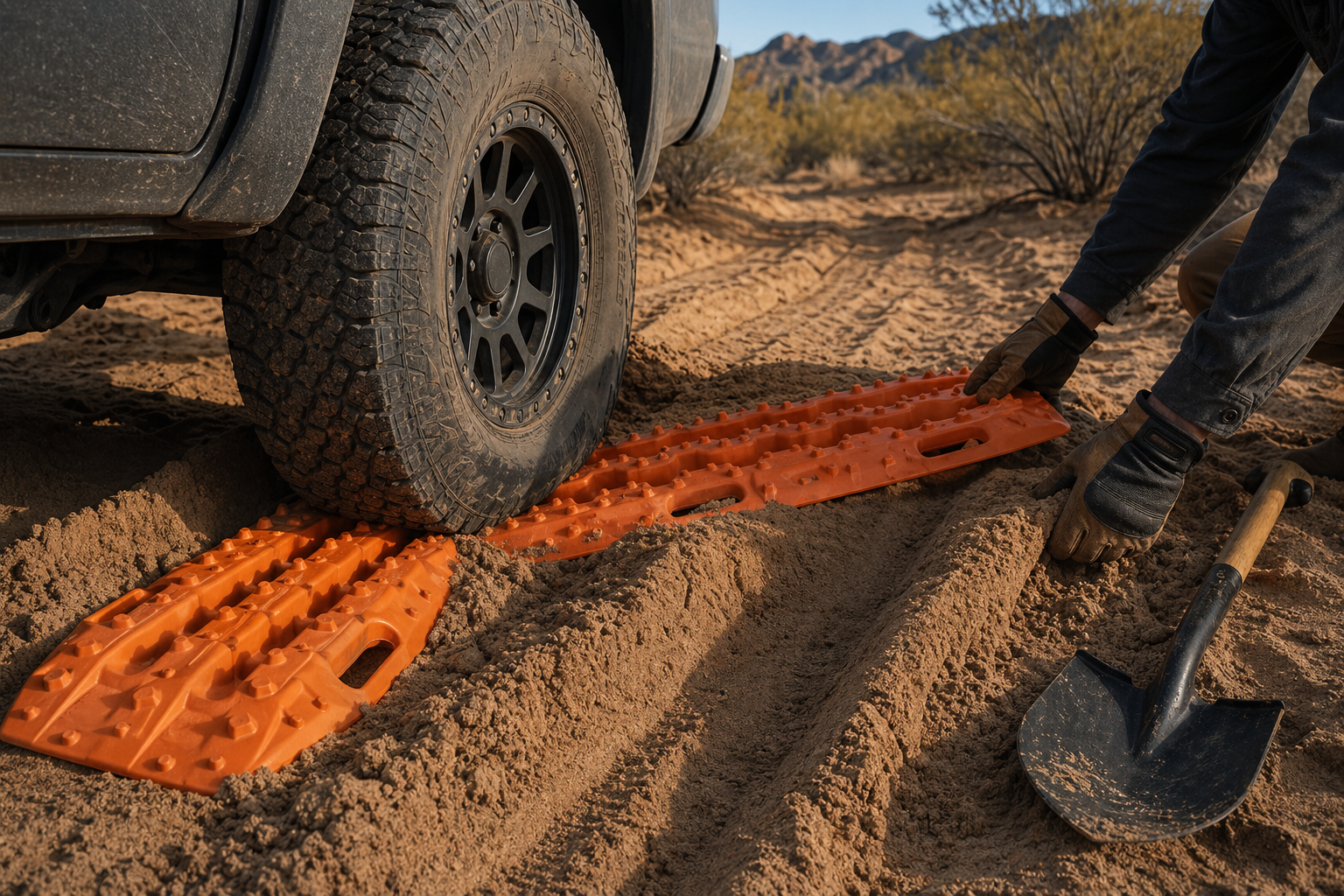
Traction boards work when the tire can climb onto them. That means you usually need to stop spinning, dig out the tire path, wedge the boards hard under the tread, and drive with patience instead of burying them.
Stop making the hole deeper
The first recovery move is taking your foot out of it. Wheelspin digs holes, polishes snow, sprays mud, and buries sand. Traction boards are meant to give the tire a firm ramp out, but the board has to touch the tire and the vehicle has to be able to climb.
Before you grab boards, look at why the vehicle is stuck. Are the tires buried? Is the frame high-centered? Are you pointed uphill? Is one tire hanging light? The answer changes where the boards go and whether you need to dig first.
| What happens | Likely problem | Better move |
|---|---|---|
| Tire spins before touching the board | The board is too far forward or the tire faces a vertical wall. | Dig a longer ramp and shove the board nose under the tread. |
| Board shoots backward | Too much wheel speed, not enough board bite, or people are standing in the wrong place. | Stop, clear everyone, reset the board tighter, and crawl instead of throttle. |
| Vehicle climbs then stops again | You solved the first hole but not the next few feet. | Reset boards in stages. Win six feet at a time instead of trying to blast through. |
| Tires climb but belly drags | The vehicle is high-centered, so the tires cannot carry enough weight. | Dig under frame, axle, hitch, and skid plates before using more throttle. |
BOARD PLACEMENT
Make the tire climb, not spin
A board lying near a tire is just trail decoration. The leading edge needs to be shoved into the tread path with a ramp cleared ahead of it.
- 1. Clear the holeDig sand, snow, or mud away from the front of the tire.
- 2. Build a rampThe board should continue the ramp, not start above a vertical wall.
- 3. Wedge hardPush the teeth under the leading edge of the tire.
- 4. Crawl onto itUse low gear and smooth throttle. Stop if the board moves instead of the vehicle.
Where people should stand
Nobody belongs in front of or behind the tire path while the driver is applying throttle. Boards can kick, flip, bury, or shoot backward when the tire spins.
BOARD LIMITS
When boards are the wrong first move
Boards are excellent at giving a tire something to climb. They are not magic ladders for a vehicle that is already resting on its frame.
| Problem | Why boards struggle | Do this first |
|---|---|---|
| High-centered | The tires are not carrying enough weight to bite. | Dig under frame, diff, axle, hitch, or skid plates. |
| Vertical tire hole | The tire hits a wall before it reaches the board. | Dig a long shallow ramp into the board. |
| Deep mud suction | The board may disappear or slide before the tire climbs. | Clear mud from the tread path and reduce suction around the tire. |
| Wrong direction | The board helps you move toward a worse obstacle. | Recover backward if your tracks are the easier escape. |
TEAMWORK
Use one spotter, one driver, one plan
The driver should know exactly which direction to move, how far to go, and what signal means stop. Everyone else should be out of the board path and away from the tires. If the spotter has to yell over engine noise and spinning tires, the recovery is already too chaotic.
BOARD LOGIC
Match the board to the stuck problem
Same tool, different job. Sand, snow, mud, and rocks all need a slightly different version of "make a ramp."
| Stuck in | Board setup | Driver move |
|---|---|---|
| Sand | Air down first, dig a long shallow ramp, and bury the board nose under the tire. | Smooth throttle. No tire speed. |
| Snow | Clear packed snow from the tire face and avoid polishing ice under the board. | Idle or very light throttle; stop before the board shoots out. |
| Mud | Dig suction away from the tire and clean enough tread for the board teeth to grab. | Let the tire climb; spinning only slicks everything up. |
| High-centered | Dig under frame, axle, hitch, or skid plates before expecting boards to work. | Do not force it until the tires have weight on them. |
Choose the recovery direction
The easiest path is often back the way you came, because your tracks already packed some surface and the obstacle proved it would let you in. Forward may still be right, but do not assume it.
If the vehicle is bellied out on sand, mud, or snow, boards alone may not help until you dig under the frame, axles, hitch, or skid plates. The tires need weight and a ramp.
Place boards correctly
Clear a ramp in front of the stuck tires. Push the board under the leading edge of the tire so the tread can bite immediately. If the board is just touching the sidewall or sitting flat in front of the hole, the tire will spin before it climbs.
Use boards on the drive tires first. If you have four-wheel drive and enough boards, use more than one axle. Keep people clear of the board path.
Recover, reset, repeat
Drive gently until the vehicle climbs onto the boards. Do not floor it. If the boards move, stop and reset. If the vehicle moves a few feet, stop on firmer ground and reassess before charging into the next bad patch.
Attach leashes or bright markers if your boards have them. Sand and snow can swallow boards fast, and searching for black plastic in the dark is not a great ending.
The board is helping
- You dug a ramp before using throttle.
- The board is wedged into the tire path.
- The driver uses steady throttle and stops when progress stops.
Reset before it launches
- Boards sit flat several inches in front of the tire.
- People stand behind the board path.
- The tire is spinning fast enough to melt, fling, or bury the board.
Field note
Traction boards are slow tools. The moment you rush them, they start working against you.