01
Wrap once
Take the working end around the support one time. Keep it flat against the object.
 By Chris Follin
KNOT SKILLS
A clove hitch is fast. That is why it is useful, and also why it needs judgment. It is great for temporary attachment to a pole or post, but it can slip or roll when the load changes direction.
The clove hitch is handy when you are rigging something quickly: a tarp pole, a temporary line on a rail, a lantern line, or a rope you expect to adjust again. It is easy to tie and easy to untie, but it earns that convenience by being less secure than a better finished knot.
THE ROPE PATH
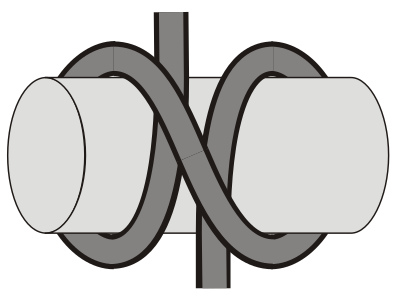
A clove hitch should be readable at a glance: two wraps around the support, a clear X where they cross, and a working tail that exits under the final wrap.
| Situation | Use the clove hitch? | What to do |
|---|---|---|
| Temporary tie to a post, rail, tree, tarp pole, or roof-rack bar | Yes. | Dress it cleanly and keep the pull direction predictable. |
| Load may bounce, reverse, or go slack overnight | Maybe. | Add a backup half hitch or use a more secure knot. |
| Slick cord on a smooth metal pole | Risky. | Back it up, add friction, or use a different attachment. |
| You need adjustable line tension | No. | Use a taut-line hitch or trucker's hitch depending on the load. |
| You need a fixed loop to clip or untie later | No. | Use a bowline. |
Take the working end around the support one time. Keep it flat against the object.
Bring the working end across the standing line. This crossing is what creates the visible X.
Continue around the support again. The two wraps should sit beside each other, not piled into a wad.
Pass the working end under the second wrap and pull it through so the tail is visible.
Pull both ends in opposite directions so the hitch seats cleanly against the support.
If the load can shake, reverse, or go slack, add a half hitch with the tail around the standing line.
A clove hitch depends on friction around the object. If the object is slick, the rope is slick, the load alternates, or the line goes slack and reloads, the hitch can creep, roll, or loosen. That does not make it useless. It means it needs the right job.
| What you see | Problem | Fix |
|---|---|---|
| Two wraps but no X | The wraps are stacked instead of crossed. | Retie so the second wrap crosses the standing line. |
| The tail disappears behind the pole | You cannot inspect where the working end exits. | Rotate or retie so the tail is visible. |
| The hitch walks around the pole when pulled | The pull direction or surface is wrong for the knot. | Reposition it, add a backup, or switch knots. |
| It loosens every time the line flaps | The load is not steady enough. | Use a backed-up hitch or a more secure attachment. |
For anything you care about staying put, add a half hitch with the tail around the standing line, or choose a more secure knot. The backup is especially worthwhile on smooth poles, synthetic cord, and overnight shelter lines.
I think of the clove hitch as a quick temporary attachment. If I care about it staying put overnight, I back it up.