01
Make the small loop
Make a small loop in the standing line. The big loop you actually want will sit below the knot body.
 By Chris Follin
KNOT SKILLS
A bowline is the camp knot I want when I need a fixed loop that stays a loop. It does not cinch down like a noose, it is easy to inspect, and it usually unties after a normal shelter or utility load.
A lot of camp knots either slide, cinch, or jam. The bowline gives you a predictable loop. That makes it useful for clipping to a tarp corner, tying to a ring, making a handle, or creating a loop that should not crush what it is around.
THE ROPE PATH
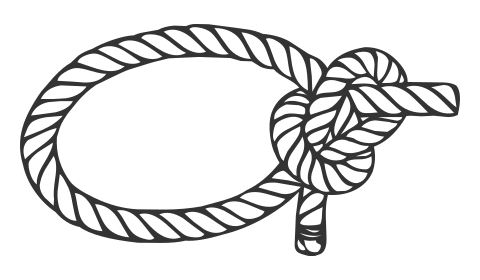
The bowline is easy to inspect because the path is simple: make the small loop, send the working end through it, wrap around the standing line, then bring the working end back through the same small loop.
| Situation | Use the bowline? | Better choice if not |
|---|---|---|
| Tarp corner, light tie-out, gear loop, or line to a ring | Yes. This is exactly the fixed-loop job. | Back it up if the rope is slick or the load will shake. |
| Guyline that needs to tighten and loosen through the night | No. The bowline will not adjust under tension. | Taut-line hitch or the tent's built-in tensioner. |
| Ridgeline that needs real pull between two anchors | Only for the fixed end. | Trucker's hitch for the tensioning end. |
| Quick tie around a pole where you will remove it soon | It works, but it is slower than needed. | Clove hitch, backed up if the load shifts. |
| Climbing, towing, recovery, rescue, or anything life-safety | No. | Rated gear, proper training, and the correct system. |
Make a small loop in the standing line. The big loop you actually want will sit below the knot body.
Pass the working end up through the small loop. This is the move that starts the fixed-loop structure.
Wrap the working end behind and around the standing part. Keep the wrap clean so the knot dresses flat.
Bring the working end back down through the original small loop. It should not go through a new hole.
Pull the standing line and the big loop apart while holding the tail. The collar should snug around the standing line.
Do not trim it visually tight. If the tail is short, the knot has less room for movement before it becomes a problem.
| What you see | What it means | Fix |
|---|---|---|
| The loop shrinks when you load it | You made a sliding knot, not a fixed loop. | Untie it and rebuild the rope path from the small loop. |
| The tail is short or buried | The knot has no warning margin if it loosens. | Retie with a longer working end. |
| The collar is rolled over or crossed | The knot is dressed poorly and harder to inspect. | Dress it flat before loading it. |
| It loosens after bouncing around unloaded | Some bowlines do this in slick or stiff rope. | Back it up with a stopper or use a different attachment. |
Use a bowline where you need an attachment loop: a tarp tie-out, a light gear line, a loop around a smooth post, or a utility loop you may want to untie later. For adjustable tension, use a taut-line hitch. For strong line tension, use a trucker's hitch.
A bowline can loosen if it is unloaded, shaken, tied in slick rope, or left with a short tail. Back it up if the load matters, and never let a simple camp knot become pretend safety equipment.
I use a bowline when I want a fixed loop. If I am trying to tighten something, I choose a tension knot instead.