 By Chris Follin
BATTERY SKILLS
How to charge a dead battery
Charging a dead battery is not the same as jump starting it. Identify the battery type, pick the right charger mode before the clamps go on, keep the area ventilated, and treat heat, smell, swelling, leakage, or repeated failure as a stop sign.
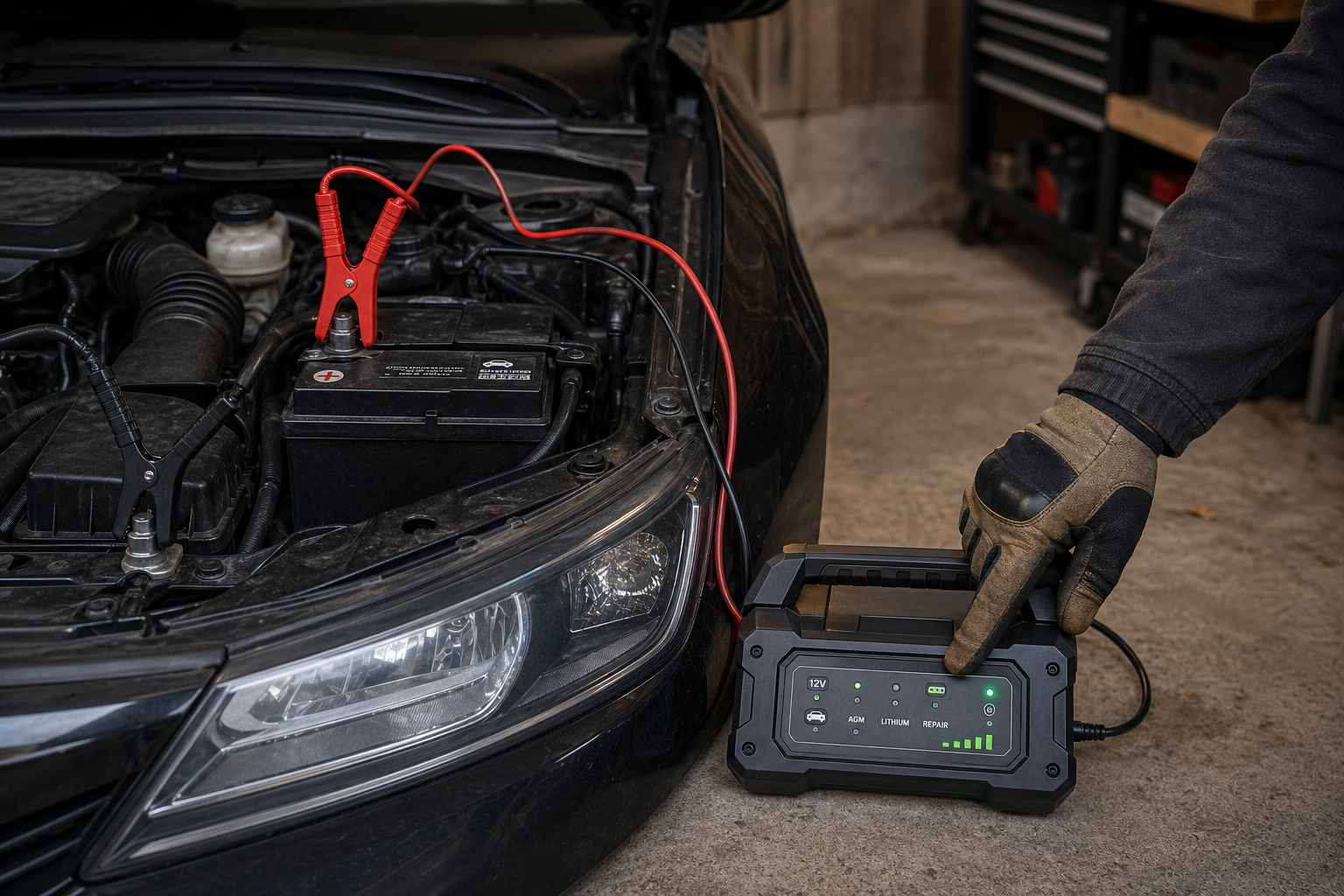
Use a charger, not impatience
A jump start borrows enough current to start the vehicle. A charger restores energy to the battery over time. If a battery is truly dead, a proper charger is usually gentler and more informative than repeated jump starts and short drives.
Read the charger manual and battery label before anything gets powered. Most passenger vehicles use a 12V lead-acid family battery, but flooded, AGM, gel, EFB, and lithium batteries do not all want the same charging behavior. A smart charger helps only after you select the right mode.
BEFORE YOU WALK AWAY
A charger should make the situation calmer
If the setup feels sketchy before the charger starts, charging will not improve it. Fix the location, identify the battery, and make the connection boring before you energize anything.
- Read the labelBattery type, voltage, warnings, and manufacturer-specific charge limits come before the charger menu.
- Ventilate the areaCharging lead-acid batteries can release explosive gas. Keep sparks, flames, cigarettes, and grinding work away.
- Connect coldMake clamp connections with the charger unplugged or switched off, then energize the charger after the clamps are secure.
- Check back earlyFeel for heat, smell for anything odd, and make sure clamps and cords are still settled after the charge begins.
CHARGER CHOICE
Pick the mode before the clamps go on
The charger setting matters because different batteries want different charging behavior. The label on the battery and the charger manual beat guesswork.
| Battery or charger situation | Better move | Why |
|---|---|---|
| Standard flooded, wet, gel, EFB, or maintenance-free lead-acid | Use the charger's normal 12V lead-acid mode if the battery label matches. | This is the common car-battery lane, but it still needs ventilation and monitoring. |
| AGM battery | Use 12V AGM mode when the charger provides it. | AGM batteries can use a different charging profile than flooded batteries. |
| Lithium or LiFePO4 starting battery | Use only a lithium-compatible charger mode and the battery maker's instructions. | Lithium batteries rely on their BMS and should not be treated like a flooded car battery. |
| Battery is below the charger's detection threshold | Stop and read the charger manual before using force or recovery modes. | Those modes can disable normal protections or use higher voltage. |
| Battery gets hot, vents, leaks, smells, swells, or will not hold charge | Stop charging and disconnect safely. | That is a failure signal, not a reason to wait longer. |
Do not revive every dead battery
A battery that is frozen, cracked, leaking, swollen, very hot, or repeatedly dead after a proper charge is not asking for more optimism. Replace it or have it tested. Repeated charging can hide the problem long enough to strand you again.
Before charging
Park in a ventilated area away from open flame and sparks. Turn the charger off or unplug it before connecting clamps. Identify positive and negative. Clean severe corrosion only if you can do it safely with eye protection, gloves, and enough light to see what you are touching.
If the vehicle manual specifies remote charging posts, use them. Some modern vehicles monitor battery current and do not like random connections bypassing sensors. If the battery is under a seat, in the trunk, in a tight compartment, or paired with a hybrid/EV system, the manual wins.
Pick the right charge mode
Use the battery chemistry mode that matches the battery: flooded/wet lead-acid, AGM, gel, EFB, or lithium if applicable. Use a slower automatic charge unless the charger and battery specify a faster rate. Automatic maintainers are useful for keeping a healthy battery topped off, but they may not recover a severely discharged or damaged battery.
If the charger refuses to start because voltage is too low, do not trick it just to make the lights blink. On NOCO Genius chargers, force mode is specifically for batteries below the normal detection threshold, and NOCO warns that force mode disables safety features while live power is present at the connections. That is a manual-in-hand situation, not a casual button press.
SMART CHARGERS
Let the charger diagnose, then believe it
A good smart charger is useful because it tells you what kind of problem it sees. Reverse polarity, high voltage, temperature faults, and bad-battery warnings are not annoyances to clear; they are reasons to stop and fix the setup.
Know when to stop
A smart charger will usually indicate full or maintenance mode. After charging, let the battery rest and test voltage. If it drops quickly or cannot start the vehicle, the battery may be worn out or the vehicle may have another problem.
Do not keep charging a battery that gets hot, smells rotten, leaks, swells, or behaves strangely. Disconnect safely and replace or test it professionally.
The charge is behaving
- Correct charger mode for the battery type.
- Connections are clean, tight, and away from moving parts.
- Battery charges without heat, smell, leakage, or aggressive venting.
- Charger reaches full or maintenance without errors.
Stop charging and inspect
- Battery is frozen, cracked, leaking, swollen, hot, or rotten-smelling.
- Charger mode is guessed or an override mode is being used casually.
- The charger shows bad-battery, polarity, high-voltage, or temperature faults.
- The battery reaches "full" but dies again quickly.
Source-backed rules worth keeping
Interstate Batteries' charging guidance calls for jewelry removal, gloves and safety glasses, the right charger for flooded, AGM, EFB, gel, or lithium batteries, and stopping if the battery gets hot, leaks, smokes, smells odd, or swells. NOCO's current Genius guidance separates normal 12V, 12V AGM, and 12V lithium modes, warns that force mode disables safety features, and says repair mode is for 12V lead-acid batteries only. OSHA's battery-charging standard backs the ventilation principle: charging areas need ventilation so gases from batteries do not accumulate into an explosive mixture.
Field note
Charging is a slow diagnostic process. If you have to force it, something is probably wrong, and the charger is often trying to tell you that.